Why a cooling system is also a dehumidifier — and a mold factory
Every central air conditioner pulls heat out of indoor air by passing that air across a cold coil. Cold air holds less moisture than warm air, so water condenses on the coil the same way it condenses on a glass of ice water in July. On a 78°F Panhandle afternoon with outdoor dew points above 70°F, a residential AC unit can produce 5 to 20 gallons of condensate per day. All of that water has exactly one job: get out of the house through the condensate drain line.
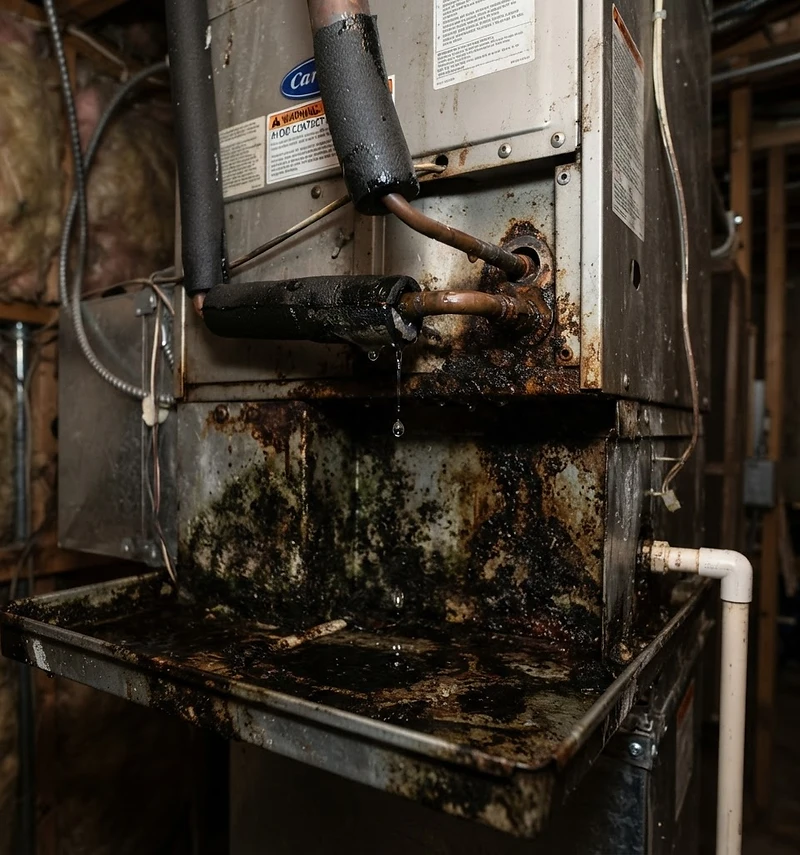
When the drain line is clear, the system is a dehumidifier working in your favor. When it clogs — and on the Panhandle it clogs often, because dust, pollen, and algae love a warm, dark, wet tube — the water backs up into the drain pan, overflows the pan, and soaks the surrounding drywall, insulation, and the air handler itself. That standing water plus dust plus 80°F plus darkness is the exact recipe for rapid mold colonization. We find HVAC-driven mold more than any other single source on Florida inspections.
The four failure points — and what each one looks like
HVAC-driven mold almost always traces back to one of four specific failures. Knowing the signature of each one tells you where to look before it becomes a remediation job:
- Clogged condensate drain line. The most common. Algae and biofilm build up in the line over months until water can't exit. The pan overflows silently, running down the inside of the wall cavity below the air handler. First sign: a small wet spot on the ceiling or wall directly under the indoor unit, or a musty smell when the AC runs.
- Cracked or rusted drain pan. The pan under the coil is a shallow sheet-metal or plastic tray. On coastal homes in Gulf Breeze and Navarre, salt air corrodes metal pans years faster than inland. A pinhole leak weeps continuously, soaking the surrounding drywall for weeks before it's visible.
- Oversized unit short-cycling. A common new-construction mistake in Pace and Milton: an AC unit too large for the home cools the air fast and shuts off before it has run long enough to pull moisture out. The home feels clammy at 74°F because humidity stays at 65%+. Short-cycling doesn't leak water, but it leaves the house perpetually above the mold threshold.
- Failed coil seal and dirty evaporator coil. A coil caked in dust holds moisture against itself, growing mold directly on the coil — and every time the fan runs, it blows mold spores down every supply vent in the house. First sign: a persistent earthy smell from the vents and dark speckling on the supply registers.
If you can see the condensate drain line from the air handler to the outside wall, you can prevent the most common mold source in your home with a twice-yearly pour of warm water and a little vinegar. The line is the whole game.
The supply-vent smell test — and what it means
A reliable self-check that takes ten seconds: walk to a supply vent while the AC is running and inhale. A healthy system smells like nothing — just cool air. A musty, basement, or wet-sock smell is mold or biofilm somewhere in the air stream, most often the coil, the pan, or the lined supply plenum. That smell is spores being delivered into every room. It is not something to mask with a vent clip; the source has to be cleaned and the moisture fixed.
A dirty-sock or vinegar smell, by contrast, is often coil residue or a bacterial film rather than mold — still worth a coil cleaning, but not necessarily a remediation. The musty, earthy smell is the one to act on.
The maintenance routine that actually prevents HVAC mold
The good news: the failure points above are almost entirely preventable with a short, cheap routine. On the Panhandle, where the AC runs eight months a year, do this:
- Pour a cup of warm water followed by a quarter-cup of white vinegar down the condensate drain line every spring and fall. It dissolves the biofilm before it becomes a clog. If the line exits outside, watch for the water to come out — if it doesn't, you already have a clog forming.
- Change the air filter monthly from May through October. A clogged filter starves the coil of air, the coil gets colder and freezes, then thaws and dumps a gallon of water all at once — overwhelming the pan and the drain. A $12 filter prevents a multi-thousand-dollar leak.
- Have the coil professionally cleaned once a year. A clean coil both dehumidifies better and removes the dust film mold colonizes. This is the single highest-value HVAC service for mold prevention.
- Ask your HVAC tech to inspect the drain pan and float switch every service visit. A float switch shuts the unit off if the pan overflows — a $40 part that turns a flooded ceiling into a non-event.
- Check the vent smell monthly and look at your supply registers for dark speckling. Caught early, a coil mold problem is a cleaning; caught late, it's a remediation of the air handler, the plenum, and the duct lining.
When it's already moldy — what remediation of an HVAC system involves
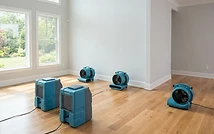
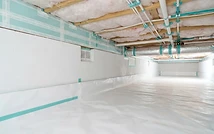
If the coil, pan, or supply plenum has visible growth, wiping it down doesn't resolve it. Mold on a coil grows into the fins and the lining behind it; the spores have already traveled the full duct run. Per the IICRC S520 protocol we follow, HVAC mold remediation means: isolating the system, removing and replacing any lined ductwork or plenum board that's colonized (you can't effectively clean porous duct liner), HEPA-vacuuming and antimicrobial-treating the coil and metal duct surfaces, and verifying with post-remediation air sampling before the system runs again.
The reason this matters: an HVAC system is a forced-air distribution network. Mold left in it continues to deliver spores to every room even after the visible growth is cleaned. Verification sampling — not a visual check — is the only way to know the air coming out of your vents is clean.
The bottom line
On the Gulf Coast, your HVAC is either your best mold-prevention tool or your worst mold source, depending entirely on whether the condensate path is clear. A clogged drain line is the single most common, most preventable, and most expensive-if-ignored mold trigger we see. Run the vinegar, change the filter, clean the coil, and install a float switch — that routine costs less than one month of a remediation project and keeps the system that cools your home from being the system that molds it.