What mildew actually is — and isn't
Mildew, in the technical sense, is a surface fungus — specifically certain species that grow on the surface of plants and on the very top layer of damp organic material. It's flat, often powdery, and stays on the surface. The pink ring in your shower, the gray film on a damp windowsill, the white powder on a plant leaf — these are mildew. It grows where moisture sits on a surface but doesn't penetrate, and it generally wipes off.
Mold is the broader category: fungi that grow into and through their food source, not just on top of it. Mold sends hyphae — root-like filaments — into drywall paper, wood, insulation, and grout. That's the defining practical difference: mildew lives on the surface and comes off with a wipe; mold lives in the material and won't. Every mildew is a fungus, but in everyday use 'mold' means a fungus that has penetrated its substrate.
The four-question sight test
Before you reach for bleach and a sponge, run the patch through this quick check. The answers tell you whether you have a wipeable surface issue or a material-penetration problem:
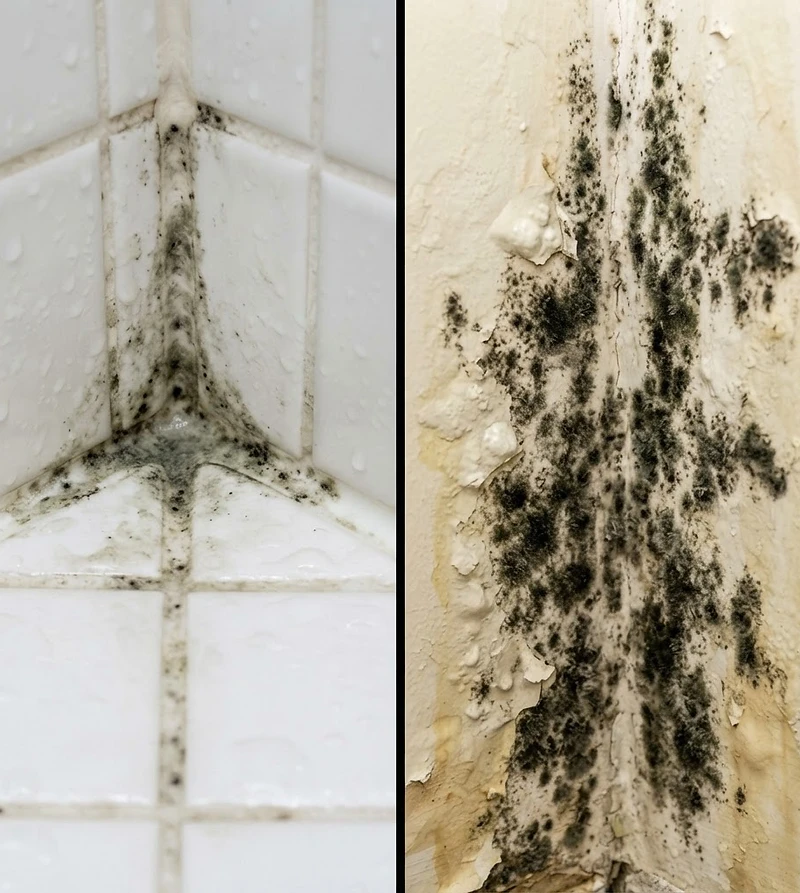
- Color and texture. Mildew is flat, dry, and powdery, usually white, gray, or pale yellow, sometimes pink. Mold is raised, fuzzy, or slimy, and tends toward green, brown, or black. A flat gray film on grout is mildew; a fuzzy dark patch on drywall is mold.
- Where it's growing. Mildew stays on non-porous or sealed surfaces: shower tile, grout, caulk, painted trim, plant leaves. Mold appears on porous, cellulose-rich surfaces: drywall, wood, cardboard, the back of wallpaper, insulation. Growth on drywall or wood is mold, not mildew, essentially by definition.
- The wipe test. Mildew wipes off cleanly with a damp cloth and a little cleaner, leaving the surface underneath intact. Mold that has penetrated the paper facing of drywall will leave a stain beneath the surface even after wiping — the discoloration sits inside the material, not on it.
- Smell. Mildew can have a faint mustiness but often little odor. A strong, persistent earthy or damp-basement smell, especially with no visible growth, is a reliable sign of mold inside a wall or under a surface. The nose is sometimes right before the eyes are.
If it's on drywall, wood, or insulation, it's mold — call it what it is. 'Mildew' is the word people use to avoid calling a remediator. On the Panhandle, that delay is what turns a one-wall cleanup into a three-room remediation.
Why the difference changes the remediation
Mildew is a cleaning problem. Fix the moisture source, wipe the surface with an appropriate cleaner, dry it, and it's resolved — the surface underneath is undamaged. A pink shower ring treated with a bathroom cleaner and better ventilation is done.
Mold that has penetrated a material is a removal problem, not a cleaning problem. Per IICRC S520, once mycelium has grown into the paper facing of drywall or into wood framing, the contaminated material is removed under containment — not wiped, not sprayed, not fogged. The colony is inside the material, and anything short of removing the material leaves the source intact to return. This is why a 'we'll spray and fog it' offer is a red flag: you cannot chemically kill your way out of material-penetrating mold and leave the colonized drywall in the wall.
The bleach trap
A common response to a dark patch is to scrub it with household bleach. Here's what actually happens: bleach lightens the surface stain, making the patch look gone, but it doesn't penetrate porous materials like drywall or wood. The water in the bleach solution soaks in and the active compound stays on the surface. On a porous surface, you've now added moisture — the one thing mold needs — to the inside of the material while cosmetically erasing the visible evidence. Weeks later the colony returns, often worse, because the moisture source is unchanged and the colonized material was never removed.
For true mildew on a non-porous surface, a bathroom cleaner or a dilute bleach solution is fine. For anything on drywall, wood, or insulation, skip the bleach and get it tested. The wrong approach makes the eventual remediation larger.
When to stop guessing and get it sampled
If the patch is on a porous surface, larger than about ten square inches, smells strongly, or keeps returning after cleaning, stop treating it as mildew and confirm what it is. A tape-lift or bulk sample sent to a lab identifies the species and the spore level — the difference between 'Cladosporium on the surface, clean it' and 'Stachybotrys in the wall cavity, remove it under containment.' That sample costs a small amount and prevents the two most expensive mistakes: ignoring real mold, and over-remediating surface mildew.
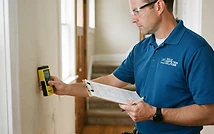
We sample before we recommend removal, because the protocol — and the price — depends entirely on what the lab confirms. A free inspection with a moisture meter and a sample is the right first step for any patch on a porous surface you can't positively identify.
The bottom line
Mildew is a surface fungus you wipe; mold is a penetrating fungus you remove. The sight test — color and texture, where it's growing, the wipe test, and the smell — tells you which one you have in under a minute. If it's on drywall, wood, or insulation, treat it as mold, confirm with a sample, and remediate per S520 rather than wiping and hoping. On the Panhandle's humid climate, that one-minute judgment is the difference between a clean rag and a containment project.