The gap a general home inspection doesn't close
A general home inspection is visual and non-invasive — the inspector walks the property, checks major systems, and flags what they can see. They are not required to open walls, use moisture meters, take air samples, or identify mold species. On the Panhandle, where the most expensive mold problems live behind drywall, under cabinets, and in crawl spaces, a visual inspection is structurally incapable of finding them.
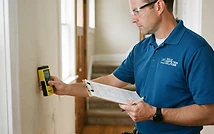
A pre-purchase mold inspection is different by design. It uses thermal imaging, pin and pinless moisture meters, and (where warranted) lab-verified air and surface sampling to locate hidden moisture and active growth the seller may not even know about — and it produces a documented scope you can use to negotiate, request repairs, or walk away before closing.
What the inspection actually covers
A real pre-purchase mold assessment is instrument-driven, not a walk-through. On every inspection we:
- Run a thermal imaging scan of every exterior wall, ceiling, and the roof deck to find temperature differentials that reveal hidden moisture behind surfaces — no demolition required.
- Map moisture content across drywall, subfloors, and framing with pin and pinless meters, producing a documented moisture map of the property.
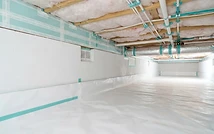
- Inspect the crawl space or basement, attic, and HVAC air handler and condensate pan — the three zones where Panhandle mold most often originates and that a general inspection barely glances at.
- Collect indoor and outdoor air samples for comparison, and targeted tape-lift or surface samples where growth is suspected, sent to an AIHA-accredited lab for species identification and spore counts.
- Deliver a written report with findings, moisture readings, thermal images, lab results, and — if mold is confirmed — a remediation scope and cost estimate you can use in price negotiations before closing.
The red flags that make an inspection non-negotiable
Some properties carry higher pre-purchase mold risk by definition. On the Panhandle, we recommend a mold inspection before closing on any home that has one or more of these:
- Age. Homes built before 1980 — especially pre-1970s Pensacola neighborhoods like North Hill, East Hill, and Belmont-DeVilliers with lath-and-plaster walls and aging cast-iron plumbing — carry the highest hidden-leak risk.
- Waterfront or barrier-island location. Gulf Breeze, Navarre Beach, and Pensacola Beach homes face wind-driven rain, salt-air seal degradation, and 75%+ baseline humidity that drives chronic envelope intrusion.
- Any history of a reported water loss, insurance claim, or storm damage. Ask the seller's disclosure for prior claims — a previous water loss is the single strongest predictor of hidden mold.
- A crawl space with a dirt floor, no vapor barrier, or visible moisture. Crawl-space mold is the #1 origin we find on Panhandle inspections, and it wicks straight up into living areas.
- A musty smell, even a faint one. The nose is often the first instrument that finds hidden mold. If the home smells damp, something is wet — and something wet on the Gulf Coast is something moldy, or about to be.
Florida seller disclosure law requires sellers to disclose known defects — but it does not require them to find defects they haven't looked for. A seller who never inspected the crawl space can truthfully say they don't know about the mold growing in it. Your inspection is the only one that looks.
How to use the report in your negotiation
A pre-purchase mold report is leverage. If the inspection finds hidden moisture or active growth, you have three paths before closing:
- Request the seller remediate and provide a clearance report before closing. This is the cleanest outcome — you close on a documented-clean home with lab-verified clearance.
- Request a price credit equal to the remediation scope and do the work yourself after closing, with your own contractor and your own clearance test. This gives you control over the protocol and the warranty.
- Walk away. If the scope is large, the moisture source is structural (a failed roof, foundation drainage), or the seller disclosed none of it, the report is your evidence for terminating under a inspection contingency.
The most expensive sentence a Panhandle homebuyer can say is 'I'll deal with it after I move in.' After closing, the mold is yours — and the remediation, the drying, and the clearance test all come out of your pocket, with no seller leverage left.
The bottom line
A general home inspection tells you the home is structurally sound; a pre-purchase mold inspection tells you whether the walls you're buying are dry. On the humid Gulf Coast, those are two different questions — and the second one is the one that costs real money. A $300 instrument-driven inspection with thermal imaging, moisture mapping, and lab-verified sampling is the cheapest insurance a Panhandle homebuyer can buy against inheriting someone else's mold problem.